From Research to Action: UNIDO and CECC Publications Outline Scalable Pathways for Clean Cooking Transition
25 November 2025 — Clean cooking is moving rapidly up the global development and climate agenda, with new evidence showing how finance, industrial value chains and technology policy can work together to deliver scale. A webinar hosted by the United Nations Industrial Development Organization (UNIDO) and the Council on Ethanol Clean Cooking (CECC), experts presented three new publications aimed at unlocking investment and accelerating universal access to clean and modern cooking solutions
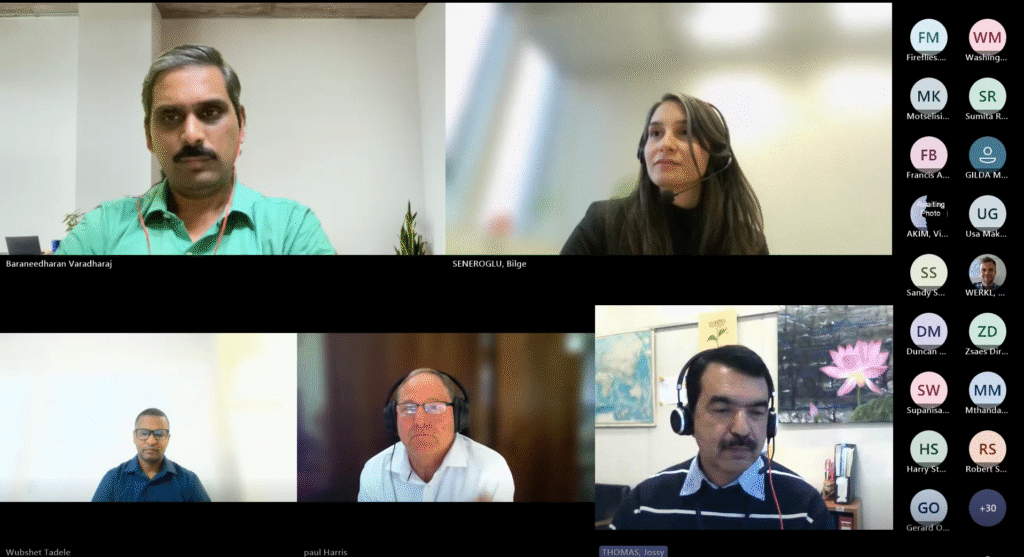
Opening the session, Jossy Thomas, Programme Manager for Clean Cooking at UNIDO, underscored that clean cooking is now recognized as both a development priority and a human rights issue. He noted that the issue has gained strong political momentum globally, including at the G20 level, and that 98 low- and middle-income countries have now integrated clean cooking or household energy goals into their Nationally Determined Contributions (NDCs). The webinar showcased the findings of three recent UNIDO–CECC publications addressing carbon finance, clean cooking transition strategies, and the industrial role of the sugar sector in scaling clean energy access.
Carbon Credits for Ethanol Cooking: A Guide for Carbon Credit Project Developers
Presenting the first publication, carbon finance expert Wubshet Tadele Tsehayu highlighted that while ethanol has proven to be a clean, renewable and widely accepted cooking fuel, access to finance remains one of the most critical bottlenecks for market scale-up, particularly for small and medium enterprises in Africa.
The guide assesses how carbon finance can serve as a results-based revenue stream to strengthen the commercial viability of ethanol cooking businesses. Although voluntary carbon markets have grown in recent years, Africa still accounts for only about 16% of global carbon credit issuance, with clean cooking representing a very small share of that total.
To address high transaction costs and technical barriers, the publication proposes an aggregator-based carbon finance model, where multiple small projects are bundled under a single coordination entity for certification, monitoring, and verification. This approach significantly lowers entry barriers and improves risk-sharing for small enterprises.
“Carbon finance is not a silver bullet, but it is a critical complementary revenue source that can unlock private investment and improve business sustainability,” Tsehayu emphasized during the presentation
Technical Brief: A Comparative Assessment of Modern Clean Cooking Fuels
In the second presentation, Paul Harris, CEO of Integrated Energy Solutions and lead author of the Technical Brief, examined the large-scale feasibility of three clean cooking pathways: electricity, liquefied petroleum gas (LPG), and bioethanol.
Harris placed the challenge in stark numerical terms: more than 400 million households worldwide still rely on polluting cooking fuels. Achieving universal access within 15 years would require converting roughly 27 million households every year. At this scale, he argued, only electricity, LPG and bioethanol currently have the capacity for rapid mass deployment.
However, each technology comes with structural constraints. Electric cooking faces grid reliability challenges, rising evening peak demand, and high upstream generation and storage costs. LPG, while widely used, carries import dependence, foreign exchange exposure, and global price volatility. Bioethanol offers strong local production and renewable advantages, but requires new industrial supply chains and coordinated investment.
“No single fuel can meet national needs on its own,” Harris noted. “Every country will need all three options in parallel, carefully planned and sequenced.”
The brief emphasizes the importance of national fuel-mix planning, aligned with grid expansion strategies, infrastructure investment and affordability mechanisms for low-income households.
Unleashing the Power of the Sugar Industry
The third publication was presented by energy and climate finance specialist Baraneedharan Varadharaj, who focused on the significant but underutilized clean energy potential of the sugar sector, particularly in Southern Africa. The analysis shows that while the region performs strongly in sugar production and agricultural yields, a large share of its potential for bioethanol production, bagasse-based cogeneration and waste-to-energy remains untapped. On average, only about half of available cogeneration capacity in sugar mills is currently exploited, and substantial bioethanol production potential remains unused.
Varadharaj estimated that up to USD 6 billion in new investment would be required to fully unlock the clean energy contribution of the sugar sector. If mobilized, such investment could significantly expand domestic ethanol supply for clean cooking and fuel blending, increase renewable electricity generation, reduce fossil fuel imports and greenhouse gas emissions, and stimulate rural employment and industrial value-chain development. He stressed the importance of integrating the sugar sector more systematically into national climate strategies and NDC implementation frameworks, as well as the need for dedicated regional investment platforms to reduce risks for private investors.
From Research to Implementation
The discussion following the presentations reinforced the message that achieving universal access to clean cooking will require coordinated government leadership, strong public–private partnerships and the alignment of industrial policy, climate finance and energy planning. Speakers emphasized that clean cooking should not be treated as a standalone energy issue but as a cross-cutting driver of public health, gender equality, climate mitigation and inclusive industrial development.
Closing the webinar, Jossy Thomas reaffirmed CECC’s role as a global multi-stakeholder platform supporting countries with practical tools, policy guidance and investment-ready research. He also noted that all three publications presented at the webinar are now freely available to support governments, development partners and private sector actors in translating evidence into concrete action. He concluded that the clean cooking transition will only succeed if complete ecosystems are built, linking fuel production, technology deployment, financing and coherent policy coordination at national and regional levels.
Watch the full webinar recording here: From Research to Action Insights from Recent UNIDO and CECC Publication